01
Customer to Producer
They spent sixteen years consuming a curriculum. You’re the first place that has to write one.
For HR, Talent & L&D Leaders
You hired sharp, credentialed people and watched too many of them stall. The instinct is to blame the generation. That instinct is expensive, and it’s wrong. The problem is the distance between the system that trained them and the one that employs them. That’s the readiness gap — and you can equip your managers to close it.
“I wish every intern and new hire had read this before they started with us.”
— Matt Kirkland, Co-Founder, Brand New Box
In person or virtual · Booking Q4 2026 & Q1 2027
The Problem
46%
New hires who fail within 18 months
Leadership IQ
89%
Of those failures are behavioral, not technical
Leadership IQ
½–2×
Annual salary — the cost of one departure
Gallup
7 in 10
Managers who’ve put a recent hire on a performance plan
Resume.org, 2025
46% and 89% from Leadership IQ’s study of 20,000+ new hires.
And that’s the cheap part. It doesn’t count the manager hours, the team drag, or the requisition you have to reopen.
Here’s what makes it fixable: none of it is a competence failure. It’s a transition failure.
School trained your early-career people to work alone, get it perfect, follow the rubric, and wait to be graded. You’re asking them to work in public, call it done at good enough, operate without instructions, and self-assess. Nobody walked them across that gap. Universities can’t, onboarding was never designed to, and their managers were never trained to.
“This isn’t a generation issue. It’s a transition issue. And your organization has more leverage over it than you think.”
— Kevin Gosa & Bryan Horvath
Your managers feel it every week. They just don’t have words for it yet.
The Keynote
Why your new hires are struggling — and what your managers can do about it.
Manager training, leadership offsite, or virtual
Kevin Gosa and Bryan Horvath have spent 20 years inside the rooms where cultures are made and early-career professionals quietly come apart. They’ve facilitated the offsites, run the leadership retreats, and been in the debriefs afterward. This keynote is what they’ve concluded.
They reframe this persistent talent problem as a structural one — then show the room exactly where the leverage sits. Onboarding design. Manager language. Feedback mechanics. Visibility norms. The unglamorous, high-return stuff that determines whether a promising hire ramps in five months or leaves in fourteen. One hour doesn’t fix your onboarding. It does change what your managers say on Monday.
It’s built for the managers who own the handoff and were never trained for it. At smaller companies it plays just as well to a mixed room — and any early-career employees in the audience leave understanding why work has felt the way it’s felt.
A clear frame for why the school-to-work transition fails, and where onboarding, mentorship, and feedback design close the gap before it becomes a retention line item.
Practical wording for coaching early-career employees where they actually are, not where managers assume they should be. The difference shows up in trust and in performance.
Five signals your early-career culture is making this worse, and the three highest-leverage moves that produce measurable change.
Want more than a keynote? Kevin and Bryan also run The Readiness Rewire, a hands-on workshop on the same framework — for new hires and early-career employees inside onboarding, where not knowing everything yet is the whole premise. Ask in the form and we’ll scope it to your org.
Listen
Two clips from a conversation about the book. No script, no slide deck, no motivational jargon. Just direct, unsentimental, and funnier than the subject deserves.
01
They spent sixteen years consuming a curriculum. You’re the first place that has to write one.
02
The habits that earned your new hires A’s are the ones your managers are fighting.
Who They’ve Worked With
Kevin and Bryan have facilitated hundreds of leadership retreats, strategic offsites, company meetings, and organizational turning points for Fortune 100 companies, Forbes top 25 charities, international NGOs, government agencies, and universities. They aren’t reporting on this problem. They’ve sat with the managers living it, and they’ve been hired to clean it up.
Kevin and Bryan are happy to connect you with past clients directly. Ask in the form.
Your Speakers
They present together. Twenty years working side by side, and it shows on stage — mostly in the good ways.

Strategic Facilitator · Co-Founder, NYC Meeting Facilitators
Kevin Gosa is a strategic facilitator and co-founder of NYC Meeting Facilitators, partnering with Fortune 100 companies, nonprofits, and government agencies to navigate high-stakes conversations and unlock organizational potential. He has spent 20 years in the rooms where culture is made — and watched the same early-career dynamics play out across every sector and generation. He previously co-authored Fire the Foosball Table.

Entrepreneur · Co-Founder, NYC Meeting Facilitators
Bryan Horvath is a facilitator, entrepreneur, and co-founder of Nonprofit Velocity and NYC Meeting Facilitators. He has advised boards and C-suite leaders domestically and internationally, designed high-stakes offsites for Forbes top 25 charities and Fortune 100 companies, and lectured for MBA programs and business conferences. He’s known for turning big-picture vision into steps a team can actually run on Monday.
The Source Material
58 Unwritten Rules for Winning at Work · Octant8 Press
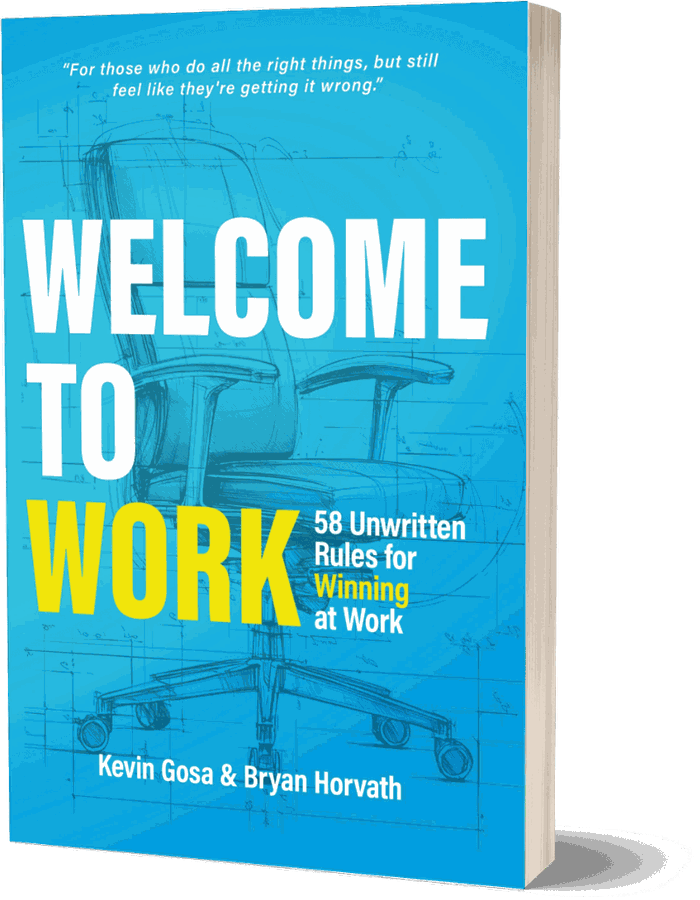
Your early-career hires did everything right. Got the degree, landed the job, showed up ready — and then found out nobody tells them how any of this actually works. Not the politics. Not the unspoken expectations. Not why some people rise fast while others stay stuck.
Welcome to Work changes that. Kevin Gosa and Bryan Horvath spent decades in strategy, leadership, and talent development watching talented people stumble over the same blind spots — and wrote the book they wish everyone had from day one. 58 practical, honest rules. No soft-skills platitudes. Just the map nobody gave them.
Organizations hand this to entire onboarding cohorts. Managers hand it to the new hire they’ve just been asked to develop. Ask about bulk pricing, licensing, and copies for every attendee in the room.
Let’s Do It
Takes about a minute. We answer everything within two business days.
Need a formal proposal? Say so in the form and we’ll include one.
Your request is in. We’ll be back to you within two business days with dates.